10 Best Floor Jacks of 2026, Trolley Jacks for the Home Garage
My family hatchback lives on the driveway, and every spring before MOT season I end up swapping wheels or checking brake pads with whatever jack is in the garage. So I spent a few weeks reading UK roundups, spec sheets and amazon.co.uk listings to find the best floor jack for cars like mine. For most home garages it's the Sealey 1.5 Tonne Aluminium/Steel Rocket Lift Trolley Jack: a light aluminium and steel frame, a twin-piston Rocket Lift and a listed maximum height of 365mm.
I haven't lifted a car on all ten, and this list doesn't pretend otherwise. It's a research ranking of capacity, lifting range, pump design and build. One rule first: a trolley jack lifts the car, axle stands hold it. Driving a big SUV or a van? Start with the Hychika or the SGS.
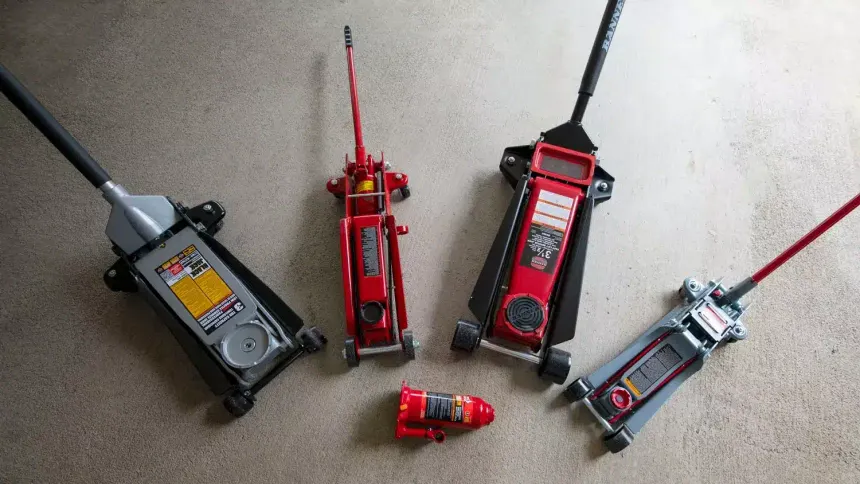

- Low saddle reach: Racing-style low chassis aimed at motorsport fans. Suits sporty hatchbacks well.
- Quick, easy lift: Rocket Lift twin pistons. The saddle reaches the jacking point in minimal pumps.
- Useful lift height: Listed maximum of 365mm. Enough for wheel swaps and brake jobs.
- Easy to position: Large saddle with a jacking pad. Easier to line up under the car.
- Solid, safe build: Steel and aluminium mix keeps it strong. Lighter than an all-steel jack.
- Sensible to store: Listed at 15.54 kg. Light enough to carry from garage to driveway.
- Capacity: Rated at 1.5 tonnes. Fine for hatchbacks, too light for big SUVs.

- Low saddle reach: Low entry design drops to 85mm. Built for reduced-clearance cars.
- Quick, easy lift: Simple hydraulic pump with a one-piece handle. No assembly faff on the drive.
- Useful lift height: Lifts to 330mm. Plenty for a wheel change on a typical hatchback.
- Easy to position: Rear swivelling steel castors. Steers into place on a flat garage floor.
- Solid, safe build: Steel chassis with a 12 months parts and labour warranty. Backed by Draper.
- Sensible to store: Short chassis at 13.2 kg. Tucks onto a shelf in a single garage.
- Short chassis: Short frame limits reach. Harder to hit central jacking points.

- Low saddle reach: Low profile body for standard cars. Starts at 12cm on the listing.
- Quick, easy lift: Quick Lift hydraulic action. Fewer strokes for a basic tyre change.
- Useful lift height: Tops out at 30cm. Enough for a wheel swap on a small car.
- Easy to position: Two fixed wheels and two casters. Rolls smoothly into place on concrete.
- Solid, safe build: Powder-coated steel with an overload safety valve. Resists damp garage rust.
- Lift range: A 30cm maximum is short for SUVs or anything riding higher.

- Low saddle reach: Low profile racing style. The lifting range starts at 90 mm.
- Quick, easy lift: Dual pumps for a quicker lift. Fewer strokes on cold mornings.
- Useful lift height: Rises to 358 mm. Comfortable for wheels, brakes and suspension work.
- Easy to position: Front roller wheel for fast access. Slides under low bumpers neatly.
- Solid, safe build: Aluminium and steel frame. Hilka covers it with a 12 month warranty.
- Load rating: At 1.5 tonnes it suits cars, not vans or seven-seat SUVs.

- Low saddle reach: Starts at 135mm. Fine for most standard hatchbacks and small SUVs.
- Quick, easy lift: Smooth hydraulic lift with minimal effort. Good for routine tyre changes.
- Useful lift height: Lifts to 330mm. Matches the AA jack for everyday wheel swaps.
- Easy to position: Swivel castor wheels. Easy to steer under the right jacking point.
- Solid, safe build: TUV/GS approved with a safety relief valve. Steel frame for longevity.
- Clearance: A 135mm start height may not clear lowered or sporty cars.

- Low saddle reach: Drops to 75mm. Slides under low saloons and sporty cars.
- Quick, easy lift: Double piston quick lift. Raises the saddle with fewer pumps.
- Useful lift height: Lifts to 505mm. Tall enough for SUVs, vans and pickups.
- Easy to position: Universal wheels roll it into place. Handy in a tight garage.
- Solid, safe build: Steel plate frame with overload protection. A 2 year warranty is listed.
- Weight: Listed at 29 kg. A real effort to lift into a boot.

- Low saddle reach: Starts at 140mm on the listing. Clears most SUVs and family cars.
- Quick, easy lift: Double-piston quick lift. Raises heavy SUVs faster than single-piston jacks.
- Useful lift height: Lifts to 525mm. Included saddle extensions take it to 677mm.
- Easy to position: Large front and rear terrain wheels. Rolls over rough yard surfaces.
- Solid, safe build: Aluminium construction with a 3-year warranty. The longest cover in this list.
- Premium cost: Premium tier. It costs more than most jacks in this list.
- Start height: A 140mm minimum is too tall for most lowered cars.

- Low saddle reach: Starts at 135mm. Clears most everyday hatchbacks and estate cars.
- Quick, easy lift: Simple pump action with a 360 degree saddle. Easy to line up.
- Useful lift height: Reaches 330mm on the listing title. Enough for a roadside wheel swap.
- Easy to position: Comes with its own carry case. Lives neatly in the boot.
- Lowered cars: A 135mm start height won't slide under low-slung sporty cars.
- Top height: A 330mm maximum is short for SUVs and raised pickups.
- Pump effort: Single pump action, so more strokes than the twin-piston jacks here.

- Low saddle reach: Drops to 98mm. The long reach chassis gets to central jacking points.
- Quick, easy lift: Dual pump pistons for fast lifting. Handy on heavier vehicles.
- Useful lift height: Rises to 535mm. The tallest standard range in this top ten.
- Easy to position: Ball bearing rear swivel casters. A bumper pad protects paintwork.
- Heavy frame: Listed at 42.6 kg. Not one to carry around the driveway.
- Floor space: The long chassis needs room. Awkward in a tight single garage.
- Garage only: Too bulky to keep in the boot for roadside punctures.

- Low saddle reach: Drops to 75mm. Slides under low sports cars and performance models.
- Quick, easy lift: Dual pump design. Lifts quickly for tyre changes and underbody jobs.
- Useful lift height: Reaches 505mm. Tall enough for vans and higher-riding SUVs.
- Easy to position: Low-profile frame on wheels. Rolls under cars with limited clearance.
- Solid, safe build: Heavy-duty welded steel frame. Comes with a 12 month domestic warranty.
- Warranty terms: Business or continuous use voids the 12 month domestic warranty.
- Air bleeding: The listing links a bleeding video. You may need to do it.
Other Trolley Jacks Worth Considering
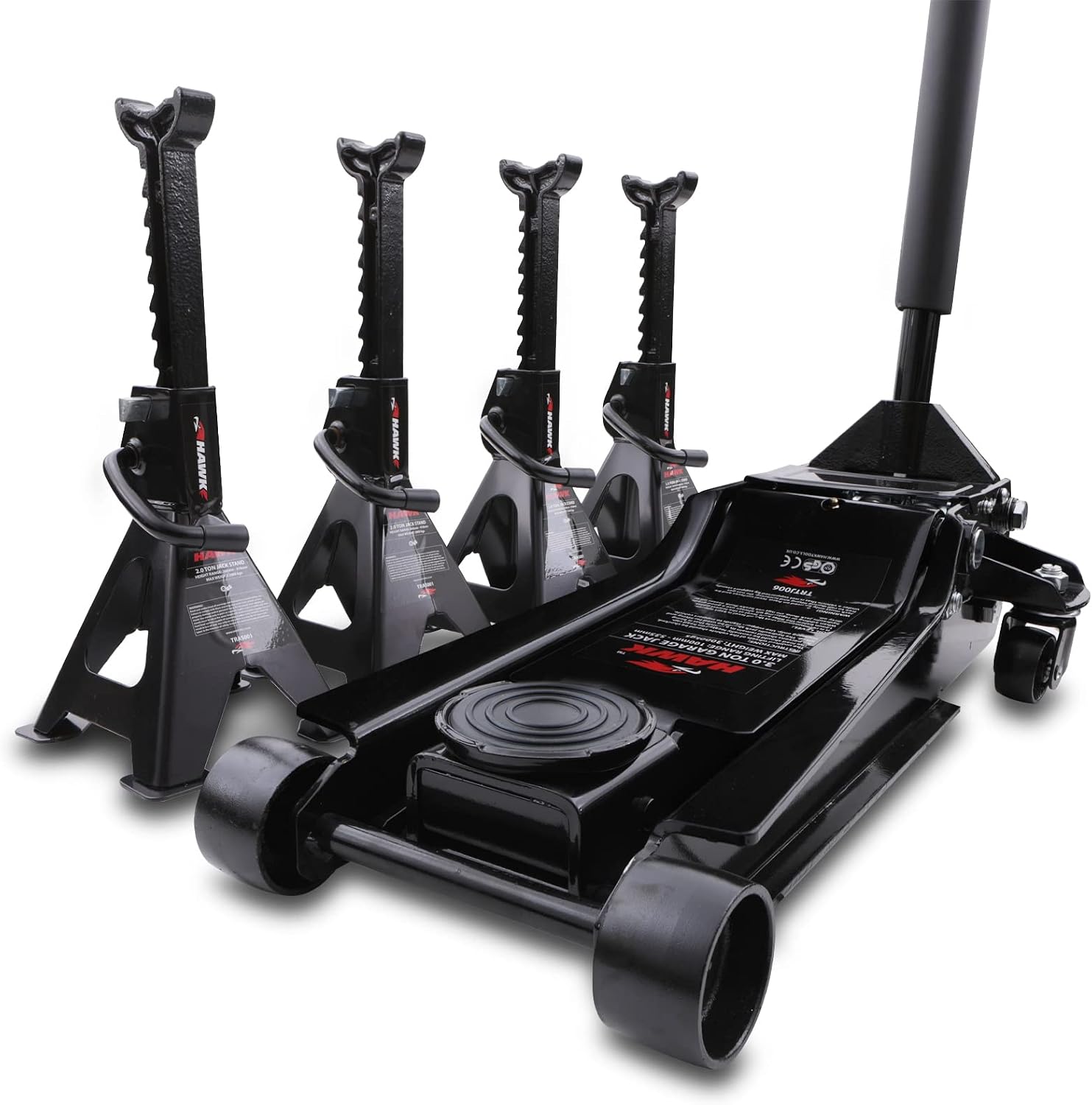
- A 3-tonne trolley jack plus four lockable ratchet axle stands in one kit.
- Twin pistons reach full extension in as few as 9 pumps.
- A removable handle and low profile make storage easier.
- Listed at 44 kg, so it's a garage kit, not a boot kit.
- The stands are listed at 2 tonnes, below the jack's rating.

- A very low 79mm saddle for lowered and track cars.
- Light aluminium construction is easy to carry to the car.
- Clarke is a long-running UK workshop brand.
- Capacity is listed at 1¼ tonnes, so smaller cars only.
- The listing gives little detail on lift height or weight.

- Dual lifting pistons for a faster lift.
- A 360° rotating rubber saddle protects the jacking point.
- Steel and aluminium build trims the weight.
- A 1.5 tonne rating rules out heavier SUVs and vans.
- A newer listing with little track record so far.

- Twin piston pump for a quick lift.
- Built from 5mm thick heavy duty steel.
- Two iron wheels and two 360 degree swivel casters.
- At 31 kg it's heavy to move around.
- No warranty term is given on the listing.
In-Depth Reviews of the 10 Best Floor Jacks
Each review explains what the listed specs mean on a UK driveway or garage floor, where each trolley jack falls short and which cars it suits.
#1 · Editor's Choice
Sealey 1.5 Tonne Aluminium/Steel Rocket Lift Trolley Jack, RJAS1500
My jacking happens on a flat patch of driveway with a family hatchback that needs its wheels and brakes checked before every MOT, so weight matters as much as lift. The Sealey RJAS1500 mixes steel and aluminium to stay manageable (the listing says 15.54 kg), and its twin-piston Rocket Lift brings the saddle up to the jacking point in minimal pumps. On a cold March morning, fewer strokes is the feature I'd pay for. It isn't for everyone, though. A 1.5-tonne rating covers hatchbacks and most saloons under the 3/4 rule, not a big seven-seat SUV, and the listing's minimum height clashes with other spec sources, so measure the gap under your sill first.
The verdict: The best floor jack for cars like a family hatchback, within its 1.5-tonne rating.
#2 · Runner-Up
Draper 2 Tonne Low Entry Trolley Jack, 02082
If your car sits low, the Draper 02082 is the jack I'd look at first. It's a low entry, short chassis design that starts at 85mm and lifts to 330mm, so it slides under cars a standard jack would scrape. Rear swivelling steel castors steer it into place, and at 13.2 kg it hangs happily on a garage wall bracket. Draper adds a 12 months parts and labour warranty. The short chassis is the trade-off: on a longer car it may not reach a central jacking point, which the long-reach SGS handles better. For a mate's lowered track-day hatch, though, it fits neatly.
The verdict: Buy it for a low car and a small garage; skip it for an SUV.
#3 · Best Budget
Homcom 2 Tonne Low Profile Quick Lift Trolley Jack
Look, this is a basic jack, and its listing is a little muddled. The Homcom is rated at 2 tonnes with a quick-lift pump, a powder-coated steel body and a safety valve for overload protection. The listing gives a lifting range of 12cm to 30cm, fine for a wheel swap on a supermini but short for anything that rides higher (other spec sources quote more, so I've stuck with the listing). The 6 months warranty is the shortest here. As a cheap floor jack for occasional punctures, it covers what most first-time buyers need, and no more.
The verdict: A sensible cheap floor jack for small cars that don't need much lift height.
#4 · Easiest to Carry
Hilka 1.5 Tonne Aluminium/Steel Racing Trolley Jack, 82815016
Most aluminium racing jacks say little on the listing. The Hilka 82815016 is clearer: 1.5 tonnes, a 90-358 mm lifting range, dual pumps, a front roller wheel and side carrying handles. Those handles matter more than they sound. When my car lived in a rented lock-up two streets from home, I carried tools back and forth constantly, and a handle on each side beats hugging a greasy frame. On paper it's a close cousin of the Sealey. My one pause is the rating; for heavier SUVs, the 2.5-tonne JCB is the aluminium option.
The verdict: The one to get for an aluminium jack with carry handles and a low start.
#5 · Best Value
Sakura 2 Tonne Hydraulic Trolley Jack, SS5191
Punctures rarely pick a convenient moment, and a jack that sits in the garage for months still has to work. The Sakura SS5191 is a plain 2-tonne steel trolley jack with a 135mm to 330mm range, swivel castors, a safety relief valve and TUV/GS approval, a useful independent safety mark at this level. It's aimed at hatchbacks and small SUVs, which is exactly where it belongs. The 135mm start height is its weak spot, since a lowered car may not clear it; that's where the Draper earns its place. Think of it as the jack version of a basic socket set.
The verdict: Good value for routine wheel swaps, but look elsewhere for lowered cars.
#6 · Best for SUVs and Vans
Hychika 3 Tonne Low Profile Heavy Duty Trolley Jack
Got a van, an SUV or a mate's pickup that turns up wanting new brake pads? The Hychika is a 3-tonne steel trolley jack with a 75-505 mm range, so it reaches under a low saloon and still lifts a high-riding 4x4. A double piston quick lift cuts the pumping, and the listing quotes a 2 year warranty. Weight is the price you pay. At a listed 29 kg it's a garage jack, not a boot jack. It shares its lifting range with the RocwooD, but the Hychika gets the nod for its longer, simpler warranty.
The verdict: The pick for SUVs, vans and pickups if you have floor space for it.
#7 · Premium Pick
JCB 2.5 Tonne Aluminium Off-Road Trolley Jack, JCB-TH32506S
Big wheels are the first thing you notice. The JCB 2.5-tonne aluminium jack rolls on large terrain wheels built for rough yards, though you should still only lift on firm, level ground. A double-piston quick lift, a 140mm minimum and a 525mm maximum (677mm with the included saddle extensions) suit off-road SUVs and light vans, and the 3-year warranty is the longest here. Now the downsides. It sits firmly in the premium tier, the listing's 36 kg weight undercuts the light-aluminium pitch, and the start height rules out lowered cars.
The verdict: Premium kit for heavy SUVs and off-roaders, overkill for a hatchback.
#8 · Best for the Boot
AA 2 Tonne Trolley Jack with Case, AA3282
Buy this if you want a jack that lives in the boot rather than the garage. The AA trolley jack comes with its own case, which keeps it from sliding about, and lifts from 135mm to 330mm on a 360 degree saddle with TUV/GS approval. It's essentially the Sakura's brief with a case thrown in. Roadside use needs care, mind. Only jack on a firm, flat surface well away from traffic, and on a motorway hard shoulder, call for help instead.
The verdict: A tidy boot jack for punctures and seasonal tyre swaps on everyday cars.
#9 · Best Long Reach
SGS 3 Tonne Low Profile Long Reach Trolley Jack
Length is the first thing to plan for. The SGS long reach chassis needs proper floor space, and at a listed 42.6 kg it's the heaviest jack here. In return you get a 3-tonne rating, a 98mm to 535mm range and dual pump pistons. The long reach is the real draw, getting the saddle to central jacking points where the Draper falls short. Honestly, it's more workshop tool than home kit.
The verdict: Worth it if you have a proper garage and work on longer vehicles.
#10 · Best for Lowered Cars
RocwooD 3 Tonne Low Profile Trolley Jack, RWTJ3.0
Salty winter roads chewed through the rear discs on my hatchback last year. The RocwooD RWTJ3.0 is a welded steel jack with a 75mm to 505mm range, a dual pump and a low-profile frame. Two things push it down the list. The 12 month warranty covers domestic users only, and the listing links a video on bleeding the jack, which hints you may need to. Fine for home use.
The verdict: A capable 3-tonne home jack with tighter warranty terms than the Hychika.
How We Researched and Scored These Floor Jacks
This ranking is built from UK editorial roundups, manufacturer spec sheets and amazon.co.uk listings, not a workshop. I didn't lift a car on any of these jacks or count pump strokes with a stopwatch. Instead, I looked at which trolley jacks independent UK reviewers kept recommending, checked each one against what its listing actually promises, then scored all ten on the same weighted criteria. Several picks have little editorial coverage, so they earned their place on specs alone.
What we compared for every jack:
- Editorial consensus: which models appeared across independent UK roundups, and in which role
- Capacity: the rated load in tonnes, judged against the 3/4 rule for the cars people actually drive
- Lifting range: minimum saddle height for low cars and maximum height for SUVs and vans
- Pump design: single pump versus twin-piston, dual pump or Rocket Lift systems
- Build: steel, aluminium or a mix, plus safety valves and TUV/GS approval where listed
- Practical fit: weight, chassis length, wheels, storage and warranty terms
How we weighted the scores:
- Lifting performance (30%): capacity, range and pump speed on paper
- Features (20%): saddle design, quick-lift systems, cases and extras
- Ease of use (20%): positioning, handle, weight and storage
- Build (15%): materials, safety valves, approvals and warranty
- Value (15%): what you get within each tier, judged qualitatively
Where a listing contradicts itself, as on the Homcom's lifting range or the Sealey's minimum height, I've gone with the Amazon title or left the number out rather than guess.
What to Look For in the Best Floor Jack
Start with capacity. A trolley jack only lifts one end at a time, but the 3/4 rule says its rating should still be at least three-quarters of the vehicle's weight. Use the maximum permissible mass on your V5C, not the kerb weight. A 1.5-tonne jack covers cars up to about 2 tonnes; a 3-tonne jack handles most SUVs, vans and pickups.
Then check the lifting range at both ends. For a lowered hot hatch, minimum height decides everything: the Draper starts at 85mm and the Hychika and RocwooD at 75mm. For an SUV, look at the top end instead; the SGS reaches 535mm. Twin-piston and Rocket Lift pumps raise the saddle in far fewer strokes. Aluminium jacks like the Sealey and Hilka cost more but you can carry them, while steel 3-tonne jacks belong on a garage floor.
Safety is not optional. A jack lifts; it doesn't hold. Once the car is up, lower it onto axle stands rated for the vehicle, on firm, level ground, with the other wheels chocked and the handbrake on. Use the jacking points in your handbook, and never put any part of yourself under a car held up by a jack alone. The Hawk kit includes four lockable stands if you need some.
Budget tiers are simple. Entry-level steel jacks like the Sakura, AA and Homcom handle wheel swaps on a hatchback, mid-range 3-tonne jacks add range, and premium aluminium models trade cost for weight. Want one trolley jack for a family car? Buy the Sealey RJAS1500 and call it a day.
Key Specs Compared
| Product | Capacity | Lifting Range | Construction | Our Score |
|---|---|---|---|---|
| Sealey 1.5 Tonne Aluminium/Steel Rocket Lift Trolley Jack, RJAS1500 | 1.5 tonnes | Up to 365mm | Aluminium/steel | 9.8 |
| Draper 2 Tonne Low Entry Trolley Jack, 02082 | 2 tonnes | 85mm to 330mm | Steel chassis | 9.7 |
| Homcom 2 Tonne Low Profile Quick Lift Trolley Jack | 2 tonnes | 12cm to 30cm | Heavy-duty steel | 9.5 |
| Hilka 1.5 Tonne Aluminium/Steel Racing Trolley Jack, 82815016 | 1.5 tonnes | 90-358 mm | Aluminium/steel | 9.4 |
| Sakura 2 Tonne Hydraulic Trolley Jack, SS5191 | 2 tonnes | 135mm to 330mm | Steel | 9.2 |
| Hychika 3 Tonne Low Profile Heavy Duty Trolley Jack | 3 tonnes | 75-505 mm | Steel plate | 9.0 |
| JCB 2.5 Tonne Aluminium Off-Road Trolley Jack, JCB-TH32506S | 2.5 tonnes | 140mm to 525mm | Aluminium | 8.8 |
| AA 2 Tonne Trolley Jack with Case, AA3282 | 2 tonnes | 135mm to 330mm | Heavy gauge | 8.6 |
| SGS 3 Tonne Low Profile Long Reach Trolley Jack | 3 tonnes | 98mm to 535mm | Steel | 8.4 |
| RocwooD 3 Tonne Low Profile Trolley Jack, RWTJ3.0 | 3 tonnes | 75mm to 505mm | Heavy-duty steel | 8.3 |
Frequently Asked Questions
What is the best brand of floor jack?
There isn't one best brand, but Sealey, Draper and Hilka are the established UK workshop names that kept turning up in my research. Sealey makes our top pick and Draper the best low-entry jack. For heavier vehicles, JCB and SGS make bigger models, and Sakura suits occasional wheel changes.
Should I get a 2-tonne or 3-tonne trolley jack?
For a supermini or family hatchback, a 2-tonne trolley jack is plenty. Go to 3 tonnes for an SUV, a van, a seven-seater or a pickup. The bigger jacks lift higher too, but most 3-tonne steel models weigh around 30 kg, which matters if you carry it.
What is the 3/4 rule for floor jacks?
It's a rule of thumb: the jack's rated capacity should be at least three-quarters of the vehicle's weight. Use the maximum permissible mass from your V5C, not the kerb weight. So a 1.5-tonne jack suits cars up to about 2 tonnes, with a safety margin built in.
Do I need axle stands as well as a trolley jack?
Yes, always. A trolley jack is designed to lift a car, not to hold it while you work. Lower it onto rated axle stands on firm, level ground, with the opposite wheels chocked. Never put any part of your body under a car supported only by a jack.
Where should I put a trolley jack under my car?
Use the jacking points shown in your car's handbook, usually reinforced sections near the sills or on the subframe. Lifting from a floor pan, the sump or a thin sill seam can dent or crack it. A rubber saddle pad helps protect the pinch weld.
What is the best floor jack to buy?
For most UK drivers with a family car, the Sealey RJAS1500 is the best floor jack to buy: light, quick to lift and rated at 1.5 tonnes. If your car is lowered, choose the Draper 02082. For SUVs and vans, the Hychika 3-tonne jack is the pick.
The Bottom Line
If you want one trolley jack for a family car on a home driveway, the Sealey RJAS1500 is the one I'd buy, 1.5-tonne limit and all. The Draper 02082 suits lowered cars, and the Hychika covers SUVs, vans and a mate's pickup. Whichever you choose, budget for a pair of axle stands too.
As an Amazon Associate I earn from qualifying purchases. See our affiliate disclosure for details. Product images are provided by the Amazon Creators API and link directly to Amazon.