10 Best Heat Guns of 2026, Corded and Cordless Picks for Car and DIY Jobs
Peeling a dealer badge off the tailgate of my family hatchback on a cold November afternoon taught me exactly what a hairdryer can't do. So I spent a few weeks reading UK roundups, spec sheets and amazon.co.uk listings to find the best heat gun for car and DIY jobs. For most garages it's the DeWalt 2000W Premium LCD Heat Gun: 2000W, an LCD display and temperature control in 10°C steps, so you can keep the heat gentle on paint and plastic.
I haven't run all ten on my own car, and this list doesn't pretend otherwise. It's a research ranking of heat range, control, handling and safety features. Two picks, the Makita and the Milwaukee, are bare cordless tools, so check you own the batteries. And treat every one with respect: they get hot enough to start a fire.

- Useful heat range: Quoted at 50-600°C. Gentle enough for decals, hot enough for paint.
- Fine heat control: LCD display with 10°C steps. Easy to dial in for plastics.
- Handy for car jobs: Low heat lifts badges and stickers. Higher heat strips flaking paint.
- Easy everyday handling: Mains powered, so no batteries to charge. Runs as long as the job.
- Safe, steady use: Thermal protection prevents overheating. Heat output stays consistent too.
- Trusted tool brand: A major trade brand. Spares and service are easy to find.
- Cost: Sits at the premium end of corded guns. More than occasional users need.

- Useful heat range: Two heat settings. Enough for paint, adhesives and shrinking jobs.
- Fine heat control: Simple toggle switch between the settings. No menus to learn.
- Handy for car jobs: Softens adhesive behind badges and decals. Dries small patches of filler.
- Easy everyday handling: A 2m cable reaches round a car. Fewer extension leads needed.
- Safe, steady use: Built-in stand for hands-free use. Stands upright between tasks.
- Trusted tool brand: Familiar DIY brand. A clear user manual is included for beginners.
- Settings: Only two heat settings. No fine control for delicate plastic trim.

- Useful heat range: 150 to 550°C on the listing. Covers trim, decals and heat-shrink.
- Fine heat control: Temperature dial plus two airflow settings. Easy to keep heat gentle.
- Handy for car jobs: No cable to snag on wing mirrors. Works anywhere on the street.
- Easy everyday handling: Runs on Makita 18V LXT batteries. Supplied in a Makpac case.
- Safe, steady use: Anti-restart function and overload fuse. A lock-off lever adds safety.
- Body only: Battery and charger not included. Budget extra if you lack LXT packs.

- Useful heat range: Three steps at 50, 300 and 600°C. Covers drying through stripping.
- Fine heat control: Three-step switch sets heat and airflow together. Simple and quick.
- Handy for car jobs: Low step suits drying and softening. Top step tackles stubborn paint.
- Easy everyday handling: Listed at 765 g. Light enough to hold up inside a wheel arch.
- Safe, steady use: Slip-resistant rubberised back for standing. Removable heat shield included.
- Fixed steps: Only three fixed steps. No fine dial for fussy plastic trim.

- Useful heat range: Quoted at 470°C. Plenty for heat-shrink, decals and softening adhesive.
- Fine heat control: Simple trigger operation. Control the heat by moving closer or further away.
- Handy for car jobs: Cordless and compact. Reaches wiring behind bumpers without a trailing lead.
- Easy everyday handling: Listed at just 1.08 kg. Easy to hold one-handed for longer spells.
- Safe, steady use: No mains lead to trip over. Safer to move around the car.
- Bare unit: Battery and charger not included. Needs an M18 pack to run.
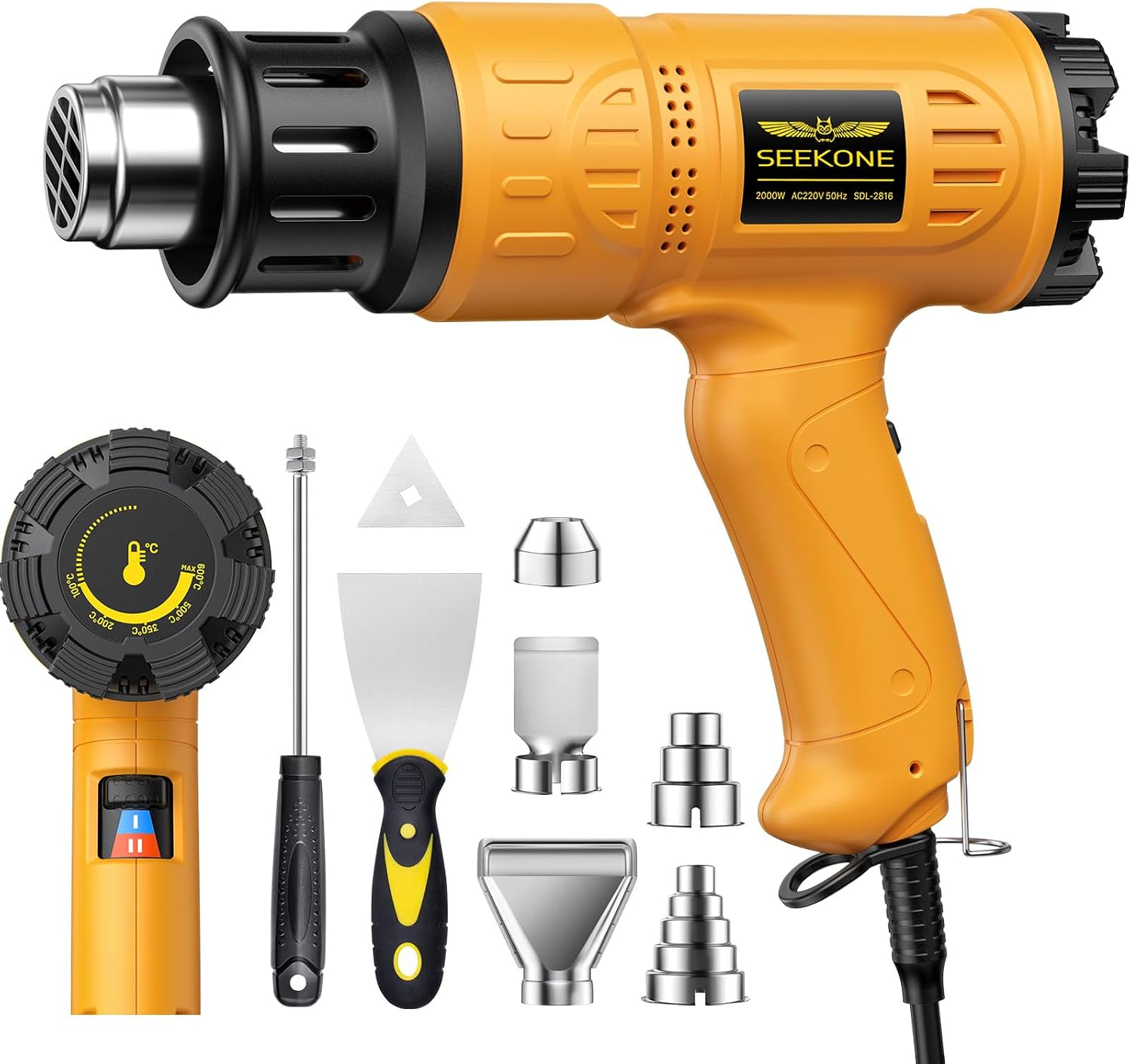
- Useful heat range: Variable dial from 50-600°C. Wide enough for crafts, trim and paint.
- Fine heat control: Heat dial plus a high/low airflow switch. Good for gentle plastics work.
- Handy for car jobs: Nozzles focus heat on heat-shrink tubing. Neat for small wiring repairs.
- Easy everyday handling: Ergonomic handle at a listed 0.9 kg. Comfortable for longer jobs.
- Lesser-known brand: A less established name. Long-term reliability is harder to judge.
- Muddled listing: Some listing specs read like a different product entirely.

- Useful heat range: Electronic control from 80°C to 650°C. The widest span in this top ten.
- Fine heat control: Continuous temperature dial with three airflow speeds. Precise for trim work.
- Handy for car jobs: Heat-shrink tubing and nozzles included. Ready for wiring repairs out of the box.
- Easy everyday handling: A 2.2 m cable and balanced weight. Reaches round the car easily.
- Safe, steady use: Storage surface for hands-free work. A heat return protection device is fitted.
- Fierce output: 2200W is a lot of heat. Easy to scorch thin plastic trim.
- Learning curve: More settings to learn than a simple two-stage gun.

- Useful heat range: Two settings at 400°C and 575°C. Suited to lighter DIY jobs.
- Fine heat control: Simple two-stage switch. Easy for first-time users to pick up.
- Handy for car jobs: Strong 675 l/min airflow helps lift old paint. Good for small panels.
- Easy everyday handling: Ergonomic handle for balance. Listed at a light 730 g.
- Safe, steady use: Thermal cut out and finned heat shield. Keeps the hot nozzle off surfaces.
- Lower power: 1600W sits below the 2000W guns here. Slower on thick paint.
- Two stages: No variable dial. Delicate plastics need care and distance.

- Useful heat range: Two settings at 350°C and 600°C. Enough for most DIY jobs.
- Fine heat control: Simple heat switch with matched airflow. The low setting suits plastics.
- Handy for car jobs: Nozzles and a scraper included. Strips paint and shrinks PVC.
- Easy everyday handling: Built-in stand and ergonomic handle. Rest it safely between tasks.
- Heat-up claims: The listing quotes conflicting heat-up times. Treat speed claims cautiously.
- Basic controls: Only two settings. No dial for fine-tuning heat on trim.

- Useful heat range: Two settings up to a quoted 550°C. Fine for general DIY.
- Fine heat control: A two-stage switch keeps things simple. Hard to get wrong.
- Handy for car jobs: Four nozzles included. Focus the heat on badges or heat-shrink.
- Easy everyday handling: Listed at 525 g. One of the lighter corded guns here.
- Safe, steady use: Light weight makes it easier to keep steady. Less arm fatigue on long jobs.
- Listing copy: Much of the listing describes other products. Check details before ordering.
- No display: No temperature readout. You judge heat by distance and results.
Other Heat Guns Worth Considering

- Two heat and two airflow settings.
- A resettable thermal cut-out switch.
- Four-piece nozzle set included.
- No variable temperature dial.
- An older design than most guns here.

- A display shows temperature and airflow.
- Six airflow modes and power-on memory.
- A power-off delay helps it cool down.
- The listing title says 220V, so check the plug.
- A little-known brand with a thin track record.

- Two temperatures with two airflow modes.
- A flat rear cover lets it stand upright.
- Four nozzles for heat-shrink and paint.
- No variable temperature control.
- A newer brand with a limited track record.

- Nine temperature settings and two airflow speeds.
- An ergonomic D-handle reduces hand fatigue.
- Five accessories including a scraper.
- The listing warns of brief smoke on first use.
- A less familiar brand than the big names.
In-Depth Reviews of the 10 Best Heat Guns
Each review explains what the listed specs mean for car and DIY jobs in a UK garage, where each heat gun falls short and who it suits.
#1 · Editor's Choice
DeWalt 2000W Premium LCD Heat Gun, D26414-GB
Precise heat is what separates a heat gun from a hairdryer, and the DeWalt D26414-GB makes it easy. This is a 2000W mains gun with an LCD display and temperature control in 10°C steps, quoted at 50-600°C, so you can sit low for the soft plastic trim on my hatchback's tailgate and go high for flaking paint on a garage door. Thermal protection stops it overheating. It isn't cheap, though, and it sits firmly in the premium tier. For one-off badge removal the Black+Decker does the job for less. For regular car and DIY work, the extra control is worth paying for.
The verdict: The best heat gun for regular car and DIY work, if the premium tier suits you.
#2 · Runner-Up
BLACK+DECKER KX1650-GB 1750W Heat Gun
Most DIY jobs need two temperatures, not twenty. The BLACK+DECKER KX1650-GB gives you a 1750W motor, two heat settings on a simple toggle switch, a built-in stand for hands-free use and a 2m cable that reaches from a garage socket to the far side of a hatchback. It's the gun I'd hand a first-timer: strip a windowsill, soften the adhesive behind a number plate, dry a patch of filler. The listing's quoted temperatures don't match other spec sources, so I've left them out. And with only two settings, thin plastic trim needs distance and patience.
The verdict: The simple corded gun to buy for occasional jobs around the house and car.
#3 · Best Cordless
Makita DHG181ZJ 18V LXT Cordless Heat Gun, Body Only
Cordless changes where you can work. The Makita DHG181ZJ runs on 18V LXT batteries, so you can heat-shrink a connector under the bonnet out on the street without trailing a lead from the house, which is the whole point when you park on the road like I do. A dial sets 150 to 550°C, two airflow settings give 120 or 200 litres per minute, and an anti-restart function adds safety. Be clear on what's in the box: it's body only, supplied in a Makpac case, with battery and charger not included. Already own Makita kit? Easy add. If not, the corded Bosch makes more sense.
The verdict: A strong cordless pick for Makita owners, and an expensive start for anyone else.
#4 · Best for Home DIY
Bosch UniversalHeat 600 1800W Heat Gun, 06032A6170
If you want three settings and no fuss, the Bosch UniversalHeat 600 is the corded gun I'd point you to. It's 1800W with steps at 50, 300 and 600°C, a removable heat shield and a slip-resistant rubberised back so it stands upright on the bench. The low step is handy for drying or warming stubborn adhesive, the top one for stripping. At a listed 765 g it's light enough to hold up inside a wheel arch. The trade-off is the fixed steps; there's no fine dial like the DeWalt's, so delicate trim relies on distance.
The verdict: Buy it for easy three-step control on general DIY and drying jobs.
#5 · Most Compact Cordless
Milwaukee M18 BHG-0 Cordless Heat Gun, Bare Unit
Look, this one is for people who already own Milwaukee M18 batteries. The M18 BHG-0 is a bare unit, battery and charger not included, so on its own it does nothing. With a pack fitted it's quoted at 470°C, heats up in about seven seconds and weighs a listed 1.08 kg. That makes it a neat fit for heat-shrinking a trailer-light connector on a mate's pickup at the kerb. There's no listed temperature control, though, so you manage heat by distance, which makes it less suited to plastics than the Makita.
The verdict: Worth it only if M18 batteries already live in your garage.
#6 · Best Value
Seekone 2000W Variable Temperature Heat Gun, SDL-2816
Value is the Seekone's whole pitch. Underneath sits a 2000W gun with a variable dial from 50 to 600°C and a high/low airflow switch, plus nozzles for shrink wrapping and heat-shrink tube. That puts proper temperature control within reach of an entry-level budget. The listing is the weak point. Parts of it read like a different product (it mentions a mount and camera compatibility), and Seekone is a less established name than Bosch or DeWalt. The lifetime warranty claim helps, if you keep the paperwork.
The verdict: Good value for variable temperature control, despite a messy listing.
#7 · Best for Car Wiring
Steinel HM 2120 E Heat Gun Set with Heat-Shrink Tubing
Car wiring is where this set earns its place. The Steinel HM 2120 E comes as a kit with a reflector nozzle, a 50mm wide jet nozzle, a reduction nozzle and heat-shrink tubing from 1.6 to 9.5mm, so you can repair a chafed wire on a reversing light without hunting for parts. The 2200W gun has electronic control from 80°C to 650°C, three airflow speeds and a 2.2 m cable. It's more than most DIYers need, mind, and at full output it'll scorch thin plastic trim in seconds.
The verdict: The kit to buy if car wiring repairs are your main heat gun job.
#8 · Best for Paint Stripping
Wagner Furno 300 1600W Heat Gun, 2359349
Old paint on a garden gate was the job I had in mind reading about the Wagner Furno 300. It's a 1600W gun with two settings, 400°C and 575°C, and a quoted airflow of 675 l/min, aimed at first-time users and lighter jobs around the home. A thermal cut-out and a finned heat shield keep the hot nozzle off surfaces, and at 730 g it's easy to hold. Lower wattage is the limit for heavier work; thick layers will go slower than with the 2000W VonHaus.
The verdict: A sensible first heat gun for light paint stripping and small jobs.
#9 · Best Budget
VonHaus 2000W Two-Setting Heat Gun with Nozzles, 15/181
Budget heat guns tend to look identical, and the VonHaus is no exception. You get 2000W, two settings at 350°C and 600°C with matched airflow, a thermal cut-off, a built-in stand and a bundle of nozzles plus a scraper. That's all most people need for stripping a door or shrinking PVC. The listing contradicts itself on heat-up time, so ignore the speed claims. Practical and plain.
The verdict: A plain budget gun that covers the usual DIY jobs.
#10 · Best Starter Kit
Brüder Mannesmann 2000W Two-Setting Heat Gun with 4 Nozzles, M49500
Simple is the point here. The Brüder Mannesmann M49500 is a 2000W corded gun with two settings and four nozzles, and spec sources quote a maximum of 550°C. At a listed 525 g it's light. I'll be straight, though: much of the Amazon listing copy describes other products entirely, so check the details before ordering. A starter gun, nothing more.
The verdict: Fine as a starter gun, once you've checked the listing details.
How We Researched and Scored These Heat Guns
This ranking is built from UK editorial roundups, manufacturer spec sheets and amazon.co.uk listings, not a workshop. I didn't strip a door or shrink a connector with any of these guns, and I didn't point a thermometer at a nozzle. Instead, I looked at which heat guns independent UK reviewers kept recommending, checked each one against what its listing actually promises, then scored all ten on the same weighted criteria. Several picks have little editorial coverage, so they earned their place on specs alone.
What we compared for every heat gun:
- Editorial consensus: which models appeared across independent UK roundups, and in which role
- Heat range: the listed temperatures, and whether the low end is gentle enough for plastics
- Control: variable dials and displays versus two or three fixed settings
- Power source: corded wattage, or the battery platform for cordless guns sold body only
- Kit: nozzles, scrapers, heat-shrink tubing and cases
- Safety: thermal cut-outs, stands, heat shields and anti-restart functions
How we weighted the scores:
- Heating performance (30%): power, heat range and airflow on paper
- Features (20%): controls, displays and included nozzles
- Ease of use (20%): weight, cable length, stands and cordless freedom
- Build (15%): safety features, brand support and warranty terms
- Value (15%): what you get within each tier, judged qualitatively
Where a listing contradicts itself, as on the Black+Decker's temperatures or the VonHaus heat-up time, I've left the number out rather than guess.
What to Look For in the Best Heat Gun
Start with control. Car jobs mostly need gentle heat: warming the adhesive behind a badge or decal, shrinking heat-shrink over a wiring repair, softening a stiff trim clip. A variable dial like the DeWalt's or Steinel's lets you stay low, while two-setting guns rely on distance. Paint stripping is the opposite job, where the top setting and strong airflow matter more.
Corded or cordless comes next. Corded guns from 1600W to 2200W cost less and run all day. Cordless guns like the Makita and Milwaukee are usually sold body only, with battery and charger not included, so they only make sense if you already own that 18V platform. If you park on the street, though, no trailing lead is a real advantage.
Safety deserves more thought than it usually gets. A heat gun can set wood, paper or dust alight, so never point it at people or pets, keep the nozzle moving and let it cool on its stand before you put it away. Under a bonnet, keep it well clear of fuel lines, the battery and plastic washer bottles. Older paint can contain lead; heat it gently, never char it, ventilate the room, wear a suitable mask and keep children away.
Budget tiers are clear. Entry-level guns like the VonHaus, Brüder Mannesmann and Black+Decker cover stripping and shrinking. Mid-range picks like the Bosch and Seekone add better control, and the DeWalt and Steinel suit regular users. Want one heat gun for car and DIY jobs? Buy the DeWalt and call it a day.
Key Specs Compared
| Product | Power | Heat Range | Power Source | Our Score |
|---|---|---|---|---|
| DeWalt 2000W Premium LCD Heat Gun, D26414-GB | 2000W | 50-600°C | Corded | 9.8 |
| BLACK+DECKER KX1650-GB 1750W Heat Gun | 1750W | Two settings | Corded | 9.6 |
| Makita DHG181ZJ 18V LXT Cordless Heat Gun, Body Only | 18V LXT | 150-550°C | Cordless (body only) | 9.5 |
| Bosch UniversalHeat 600 1800W Heat Gun, 06032A6170 | 1800W | 50 / 300 / 600°C | Corded | 9.3 |
| Milwaukee M18 BHG-0 Cordless Heat Gun, Bare Unit | M18 18V | 470°C | Cordless (bare unit) | 9.1 |
| Seekone 2000W Variable Temperature Heat Gun, SDL-2816 | 2000W | 50-600°C | Corded | 9.0 |
| Steinel HM 2120 E Heat Gun Set with Heat-Shrink Tubing | 2200W | 80-650°C | Corded | 8.9 |
| Wagner Furno 300 1600W Heat Gun, 2359349 | 1600W | 400°C / 575°C | Corded | 8.8 |
| VonHaus 2000W Two-Setting Heat Gun with Nozzles, 15/181 | 2000W | 350°C / 600°C | Corded | 8.7 |
| Brüder Mannesmann 2000W Two-Setting Heat Gun with 4 Nozzles, M49500 | 2000W | Max 550°C | Corded | 8.6 |
Frequently Asked Questions
What is the best brand of heat gun?
There isn't one best brand, but DeWalt, Bosch, Steinel and Black+Decker were the names that kept coming up in my research. DeWalt makes our top pick, Steinel the best kit for car wiring and Bosch an easy three-step gun. Makita and Milwaukee make good cordless guns, sold body only.
How many watts is a good heat gun?
For most car and DIY jobs, anything from 1600W to 2000W is plenty. Higher wattage mainly speeds up paint stripping, while badges, decals and heat-shrink need control more than power. Temperature control matters more than the wattage figure, so a variable dial is worth more than an extra few hundred watts.
Can I use a hair dryer instead of a heat gun?
For a small sticker on a warm day, sometimes. A hair dryer runs far cooler, so it struggles with badge adhesive in a cold UK winter and can't shrink heat-shrink tubing properly. It's useless for paint stripping. A heat gun on its lowest setting gives you the extra heat with far more control.
Is a cordless heat gun worth it?
Only if you already own the batteries. The Makita and Milwaukee are sold body only, with battery and charger not included, so the full cost climbs quickly. If you park on the street or work away from a socket, the freedom is real. Otherwise, a corded gun does more for less.
Can I use a heat gun to remove car badges and decals?
Yes, it's one of the best uses for one. Use a low setting, keep the gun moving about a hand's width from the paint and warm the adhesive rather than the panel. Slide fishing line behind the badge to cut it free, then lift any residue with an adhesive remover.
Is it safe to use a heat gun near car wiring and fuel lines?
Near wiring, yes, with care; heat-shrink repairs are a common job. Disconnect the battery first, use a reflector nozzle and shield nearby plastics. Keep well clear of fuel lines, the fuel tank and anything that might hold fuel vapour. If a job sits near the fuel system, use another method.
The Bottom Line
If you want one heat gun for car and DIY jobs, the DeWalt 2000W Premium LCD Heat Gun is the one I'd buy, premium tier and all. The Black+Decker suits occasional users, and the Steinel set is the pick for wiring repairs. Whichever you choose, let it cool on its stand before you put it away.
As an Amazon Associate I earn from qualifying purchases. See our affiliate disclosure for details. Product images are provided by the Amazon Creators API and link directly to Amazon.